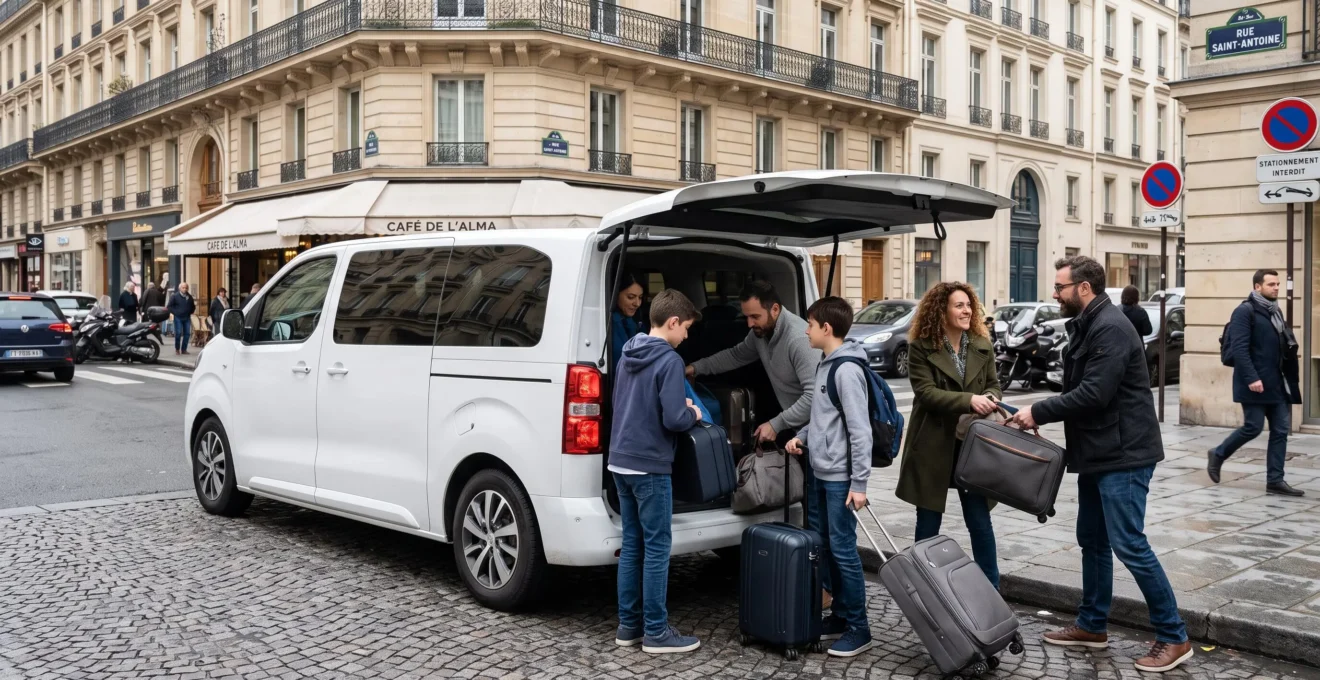
Coordinating the arrival of eight colleagues at Paris-Charles de Gaulle Airport for a two-day conference presents a familiar dilemma: book multiple taxis and risk the group fragmenting across terminals, navigate crowded public transport with luggage and jet-lagged passengers, or arrange premium vehicle services that often prove scarce and expensive. For groups of six to nine travellers, a third option eliminates these coordination headaches entirely.
A 9-seater minibus addresses the structural challenges of Paris group travel through a straightforward proposition: simultaneous capacity for an entire group plus their luggage, operated by a single driver using a standard driving licence. This combination resolves the practical friction points that make alternative transport methods frustrating for airport transfers, corporate events, family holidays and organised outings across the French capital.
The solution proves particularly effective for arrivals at CDG or Orly, where luggage volume, punctuality requirements and the 25-kilometre journey to central Paris create genuine operational challenges. Understanding why a minibus functions as the pragmatic choice—rather than merely one option among several—requires examining how it solves specific problems that alternatives cannot.
- Space and comfort: the foundation of stress-free group travel
- How does a minibus solve airport transfer challenges in Paris?
- What makes minibuses ideal for diverse group types?
- Cost-effectiveness compared to alternative solutions
- Can anyone drive a minibus in Paris?
- Practical considerations when booking your minibus
- Transforming group travel coordination from challenge to solution
Space and comfort: the foundation of stress-free group travel
The fundamental advantage of a 9-seater minibus lies in its simultaneous accommodation of passengers and luggage without the trade-offs required by standard vehicles. Unlike saloon cars or even large SUVs—which force passengers to choose between occupants and cargo space—a properly configured minibus maintains dedicated luggage capacity when all seats are occupied.
This spatial solution becomes immediately relevant at Paris airports. A multigenerational family of eight arriving at Charles de Gaulle Terminal 2E with six large checked suitcases, four cabin bags and a folding pushchair cannot fit this configuration into a single standard vehicle. The family faces splitting across two taxis, with grandparents separated from grandchildren during the 45–60 minute journey into the city depending on traffic conditions.
Airport transfers from CDG and Orly represent the primary use case where minibus capacity delivers measurable benefits. The average distance from Charles de Gaulle to central Paris spans approximately 25 kilometres, whilst Orly sits roughly 15 kilometres south of the city centre. These journeys, particularly during morning and evening peak periods, test both passenger comfort and luggage management capabilities.
Typical minibus capacity: A standard 9-seater configuration accommodates eight passengers plus driver, with dedicated boot and overhead storage typically handling six to eight large suitcases when all seats are occupied. Exact capacity varies by specific vehicle model, but the structural advantage over standard vehicles remains consistent across the rental fleet.
Consider how different group types experience this spatial advantage. A corporate delegation of seven attending a trade exhibition at Paris Nord Villepinte arrives with presentation equipment, sample cases and individual luggage. Fitting this combination into standard vehicles requires roof racks or multiple cars, whilst a minibus loads everything internally in a single movement. Similarly, an amateur football team of nine travelling to a tournament brings individual kit bags plus shared equipment—balls, medical supplies, hydration containers—requiring dedicated cargo volume that standard boots cannot provide.
Beyond raw capacity, the journey experience matters for routes spanning 45 minutes to an hour through dense Parisian traffic. Individual seating for each passenger, adequate legroom and climate control transform what might be a cramped, uncomfortable transfer into a straightforward journey. This comfort consideration proves particularly relevant for corporate contexts, where arriving at a business event after a stressful, overcrowded transfer undermines the professional image organisers aim to project.
The fundamental difference separating minibuses from alternatives lies not in luxury features but in eliminating forced compromises. Standard vehicles cannot accommodate eight passengers with full luggage loads without external storage or multiple bookings. A minibus resolves this structural constraint, keeping groups unified from airport arrival through to their final Paris destination.
How does a minibus solve airport transfer challenges in Paris?
Airport transfers expose the coordination vulnerabilities of multi-vehicle solutions. When eight delegates arrive at CDG for a conference beginning two hours later, splitting across two taxis introduces multiple failure points: one vehicle delayed in traffic whilst the other waits at the hotel, communication difficulties if drivers take different routes, unpredictable individual meter costs making budget reconciliation complex, and the fundamental risk that group members become separated during the crucial first impression of a professional event.
A single minibus operated by one driver eliminates these cascading complications. The entire group departs together, arrives together and maintains unified schedule management throughout. This operational simplicity proves particularly valuable for tight timelines, where conference start times, meeting schedules or onward travel connections leave no margin for stragglers.
Practical service innovations address a remaining friction point: travelling to a rental branch before collecting the vehicle adds time and complexity to already pressured airport arrivals. Several Paris rental operators now offer airport delivery and collection services, bringing the minibus directly to arrivals terminals or collecting it from departures. WeVan, for instance, provides this CDG delivery service, allowing groups to receive their vehicle immediately upon exiting customs rather than navigating to an off-site minibus hire branch in Paris-Nord before beginning their actual journey.
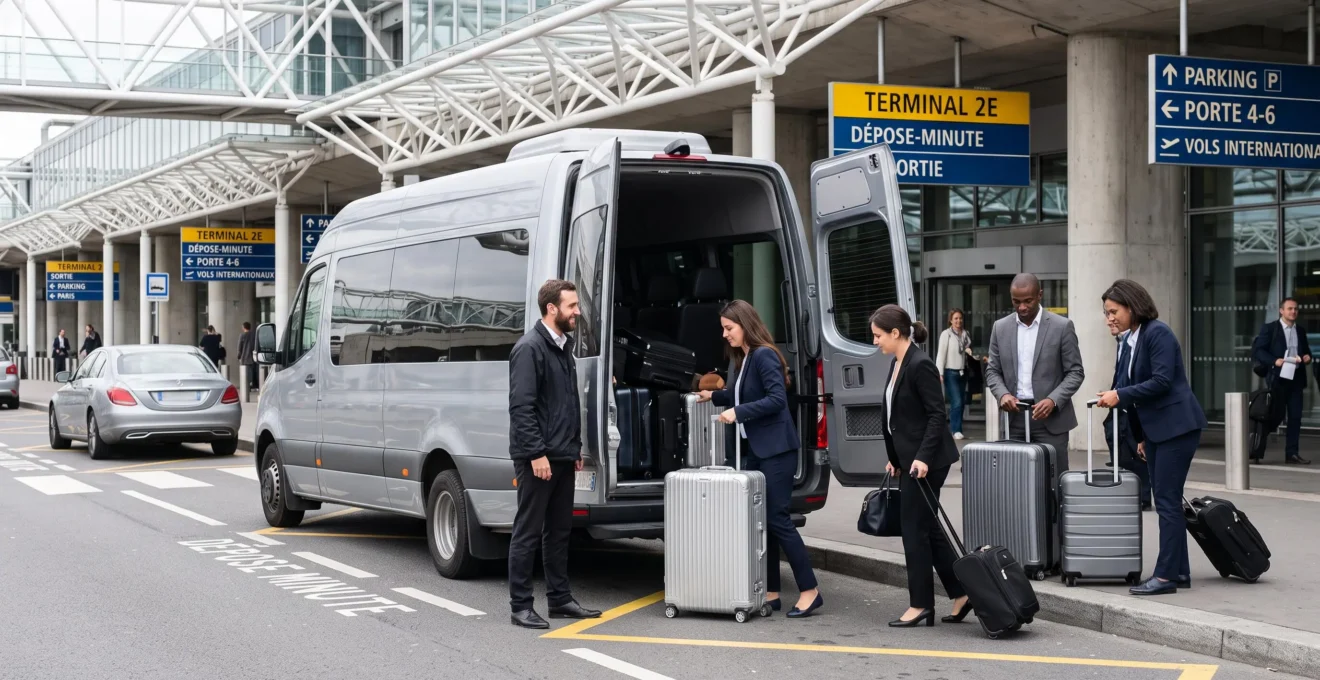
Public transport alternatives demonstrate why cheaper options often fail for airport group transfers. The RER B line connects CDG to central Paris, but boarding with six large suitcases during peak hours proves impractical. Crowded carriages lack luggage space, platform changes with heavy bags stress elderly or less mobile group members, and the overall experience projects an unprofessional image for corporate client reception. For families or business delegations, the modest financial saving cannot justify the operational frustration and reputational risk.
Premium VTC services theoretically offer driven alternatives, but vehicles accommodating eight passengers with luggage remain rare in the Paris market. Standard VTC platforms primarily deploy 4-seater vehicles, whilst 7- or 8-seat options command significant premiums and limited availability, particularly during peak demand periods surrounding major exhibitions, conferences or summer holiday departures.
| Factor | Two separate taxis | Single 9-seater minibus |
|---|---|---|
| Coordination complexity | Requires communicating with two drivers, managing separate departures, potential for different routes or arrival times | Single driver, unified departure and arrival, consistent route |
| Group cohesion | Passengers split across vehicles, elderly or children potentially separated from primary caregivers | Entire group remains together throughout journey |
| Cost transparency | Two separate meter charges or fixed fares, payment handling across multiple drivers | Single quoted rental cost, one payment transaction |
| Delay risk management | If one taxi delayed, other vehicle and passengers wait separately; communication challenges | Single vehicle, single timeline, no inter-vehicle coordination needed |
| Luggage security | Bags distributed across two boots, potential for items left behind in one vehicle | All luggage loaded and unloaded in single supervised operation |
The comparison reveals why coordination stress represents a hidden cost of multi-vehicle solutions. For event organisers managing professional delegations, the time and mental energy spent coordinating separate taxis carries real value, particularly when subtracted from other preparation tasks. A minibus converts this distributed coordination problem into a straightforward single-driver operation, delivering operational serenity alongside the obvious capacity advantage.
What makes minibuses ideal for diverse group types?
Whilst airport transfers dominate minibus use cases, different group types experience distinct benefits from the same core advantages. Understanding these specific applications demonstrates the vehicle’s versatility beyond generic “group travel” scenarios.
- Multigenerational families navigating Paris holidaysThree-generation family groups—grandparents, parents and children—face particular logistical challenges combining elderly mobility considerations with child safety requirements. A minibus accommodates multiple child safety seats alongside space for walking frames, wheelchairs or other mobility aids, whilst keeping vulnerable family members together rather than separated across multiple vehicles. The spatial configuration allows parents to supervise young children throughout the journey, whilst grandparents avoid the stress of managing unfamiliar taxi bookings or crowded public transport in a foreign city. Holiday luggage for week-long stays—five or six large suitcases, pushchairs, nappy bags—fits within dedicated cargo space without compromising passenger comfort.
- Corporate events and business delegations requiring professional presentationCompanies hosting French partners, welcoming international clients or coordinating delegate attendance at conferences face a critical first-impression challenge. The arrival experience sets expectations for the entire event; a fragmented, stressful airport transfer undermines the professional image organisers aim to project. A minibus provides cohesive client reception, maintains schedule reliability for tight conference timing, and demonstrates organisational competence through smooth coordination. Event professionals managing these logistics value punctuality guarantees and coordination simplicity above marginal cost differences, as delay risks or group separation carry reputational consequences far exceeding transport budget considerations.
- Sports teams transporting equipment alongside playersAmateur football, rugby or basketball teams travelling to Paris tournaments or friendly matches require cargo volume exceeding standard luggage scenarios. Nine players each carrying individual kit bags already challenge vehicle capacity, but shared team equipment—balls, medical kits, hydration containers, spare boots, coaching materials—demands dedicated storage space. Budget-conscious amateur clubs prioritise cost-effective solutions, making the per-person cost calculation of a single minibus rental attractive compared to coordinating multiple vehicles. The vehicle also maintains team unity during travel, supporting pre-match preparation and group cohesion.
- Student groups exploring educational and cultural programmesUniversity societies, language schools and educational tour operators coordinating Paris visits for groups of eight to twelve students face distinct supervision and budget challenges. Keeping students together simplifies headcount management and duty-of-care responsibilities during transfers between airports, accommodation and educational venues such as museums or historical sites. For those planning for student group trips across Europe, transport coordination often represents the highest stress factor, with minibuses offering supervisors direct control rather than distributed responsibility across multiple taxis or complex public transport connections in unfamiliar cities.
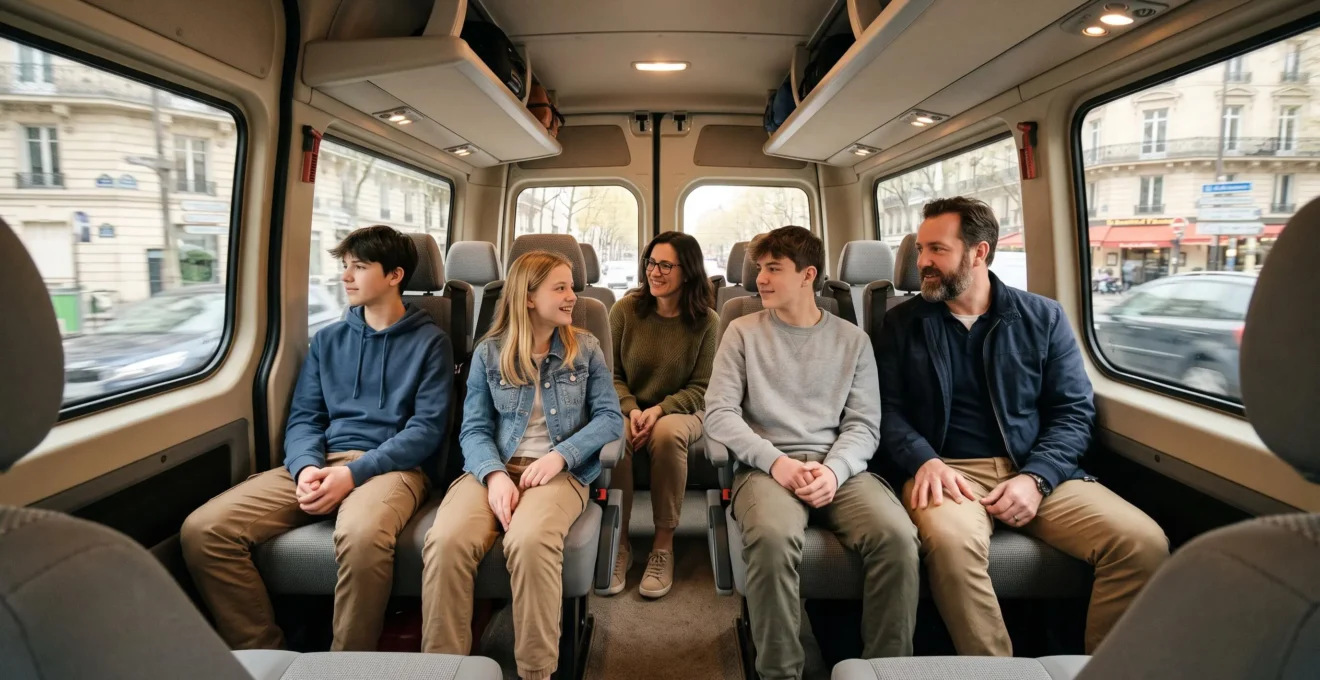
Each profile demonstrates how the same vehicle characteristics—capacity, unity, cost structure—solve different pain points. Families prioritise safety and keeping vulnerable members together; corporate clients emphasise professional image and punctuality; sports teams focus on equipment volume and budget efficiency; student supervisors value headcount control and duty-of-care simplification. The minibus addresses all these distinct needs through a single structural advantage: everyone and everything fits in one coordinated movement.
Cost-effectiveness compared to alternative solutions
Economic comparisons often focus narrowly on nominal transport prices whilst ignoring hidden costs embedded in coordination complexity, time expenditure and failure risks. A realistic cost assessment requires examining the complete picture for a concrete scenario.
Consider an eight-person group arriving at Charles de Gaulle for a weekend Paris visit, carrying six large suitcases and several cabin bags. Standard taxi capacity in France typically accommodates four passengers maximum per vehicle, meaning this group requires two separate taxis regardless of luggage considerations.
Official French regulations establish fixed forfait fares for taxi journeys between Paris and CDG, with maximum prices set through annual ministerial orders. These regulated fares apply per vehicle, meaning the eight-person group pays twice—once for each of the two required taxis. Beyond this direct cost duplication, hidden expenses accumulate through coordination effort, separation risk and payment complexity.
The coordination time value alone carries weight for event organisers or family trip planners. Communicating arrival details to two separate drivers, managing two concurrent journeys through traffic, handling two payment transactions, and ensuring both vehicles reach the correct destination without losing group members represents genuine work. For corporate event coordinators billing hourly rates, this coordination time carries quantifiable cost; for families, it transforms what should be a straightforward arrival into a stressful management exercise.
A single minibus rental eliminates these duplicated and hidden costs through structural simplification. The group receives one quoted price covering the entire rental period—whether a weekend, several days or a full week—rather than per-journey charges vulnerable to traffic-based meter variations. This budget transparency proves particularly valuable for event planners operating within strict allocated budgets, where cost certainty during planning prevents unwelcome financial surprises.
| Cost factor | Two separate taxis (multiple journeys) | Single weekend minibus rental |
|---|---|---|
| Vehicle capacity requirement | Minimum two 4-seater taxis needed for 8 passengers | One 9-seater accommodates entire group plus luggage |
| Journey-based charging | Separate fare for each journey (CDG arrival, potential city transfers, CDG departure) × 2 vehicles | Fixed rental period cost regardless of journey number within rental window |
| Coordination overhead | Time spent booking two taxis per journey, managing separate arrivals, handling dual payments | Single booking, one driver, one payment transaction |
| Traffic risk exposure | Two separate meter-based charges potentially affected by traffic delays | Rental cost unaffected by traffic conditions during journeys |
| Separation risk cost | Potential for missed meetings, conference delays or family stress if vehicles separated | Group unity maintained, schedule risk eliminated |
Per-person cost calculations make minibus rental accessible even for informal groups without corporate budgets. Dividing the weekend rental cost across eight travellers typically yields individual contributions competitive with—or lower than—their proportional share of multiple taxi fares, whilst delivering superior coordination simplicity and comfort. For families, this shared cost structure proves particularly attractive compared to alternatives requiring multiple bookings.
Premium VTC services offering 7- or 8-seater vehicles represent a third option, but availability in the Paris market remains limited. During peak demand periods—major exhibitions, summer holidays, conference seasons—larger VTC vehicles command significant premiums when available at all. Event organisers requiring guaranteed capacity for specific dates often find minibus rental offers more reliable availability than scarce large VTCs.
The economic advantage ultimately derives not from minibuses being universally cheapest in nominal terms, but from eliminating hidden costs whilst providing structural solutions to coordination, capacity and predictability challenges. For groups facing the genuine operational complexity of coordinating multiple vehicles, the total cost calculation—including time, risk and stress—consistently favours the single-vehicle approach.
Can anyone drive a minibus in Paris?
Regulatory uncertainty frequently prevents potential minibus users from even considering the option. The assumption that vehicles seating nine people require special commercial licences discourages travellers who would otherwise benefit from the capacity and coordination advantages.
French driving regulations clarify this misconception directly. According to official Service-Public.fr guidance (published by DILA, the government’s legal information directorate), a standard permis B authorises driving vehicles with a maximum authorised weight (PTAC) not exceeding 3,500 kilograms. The same licence category covers vehicles with up to eight passenger seats in addition to the driver’s seat—totalling nine places including the driver.
This dual criteria means typical 9-seater minibuses available through Paris rental fleets fall squarely within permis B eligibility, provided the specific vehicle’s PTAC remains below the 3.5-tonne threshold. Standard rental minibuses meet this weight requirement comfortably, making them legally drivable using the same licence category that authorises saloon cars and SUVs.
The distinction separating permis B from permis D addresses a common source of confusion. Permis D—the commercial passenger transport licence—becomes mandatory for vehicles exceeding nine places (more than eight passengers plus driver) or for passenger transport services operated for hire. Renting a 9-seater minibus for private group use falls entirely outside permis D requirements; the standard permis B suffices for the rental itself and all driving during the hire period.

Rental companies impose additional commercial conditions beyond basic legal eligibility. Typical requirements include minimum age thresholds—often 21 or 25 years depending on the provider—and licence holding periods of one to two years. Young driver supplements may apply for renters under 25 even when they meet the minimum age and experience criteria. These conditions reflect insurance requirements rather than legal restrictions, but they affect booking feasibility for younger travellers or recent licence holders.
Foreign licence recognition follows European Union equivalency principles. UK driving licences, for instance, authorise the same vehicle categories as permis B when used in France, meaning British event coordinators visiting Paris for corporate delegations face no additional licensing barriers. Drivers from outside the EU should verify their specific licence recognition status, though most established licensing jurisdictions maintain reciprocal recognition agreements covering standard categories.
Rental eligibility verification: Whilst permis B legally authorises 9-seater minibus operation, individual rental companies may require drivers to be 23 or 25 years old and hold their licence for at least one or two years. Check specific provider terms during booking to avoid discovering age or experience restrictions only upon arrival at the rental desk. These commercial conditions exist independently of legal driving authorisation.
Urban driving considerations deserve realistic acknowledgement without exaggeration. Paris traffic density, narrow streets in historical districts and limited parking availability present genuine challenges for any vehicle, with larger minibuses requiring greater spatial awareness than compact city cars. However, these considerations reflect urban driving realities rather than minibus-specific difficulties. Drivers comfortable navigating London, Manchester or other dense UK cities possess transferable skills directly applicable to Paris conditions. Automatic transmission options reduce workload for those unfamiliar with manual gearboxes in heavy traffic, whilst modern minibus manoeuvrability—power steering, rear parking sensors, reversing cameras—mitigates size concerns for competent drivers.
The regulatory reality removes the primary barrier preventing travellers from considering minibuses: no special licence required, no commercial authorisation needed, no additional qualifications beyond the standard permis B held by millions of European drivers. This accessibility transforms minibuses from niche commercial vehicles into practical tools available to regular travellers facing group coordination challenges.
Practical considerations when booking your minibus
Understanding why a minibus solves group travel challenges differs from executing a successful booking and rental experience. Several practical decisions and preparation steps determine whether the theoretical advantages translate into smooth operational reality.
- Book with appropriate lead time for your travel datesPeak season availability—July and August summer holidays, September Paris Fashion Week, October automotive shows, major spring conferences—demands advance booking six to eight weeks ahead for guaranteed vehicle choice. Event coordinators with fixed conference dates cannot afford last-minute availability disappointments; booking early secures preferred vehicle specifications and often better rates. Outside peak periods, one to two weeks’ notice typically suffices for standard models, though popular automatic transmission vehicles may require longer lead times.
- Select appropriate vehicle specification for your specific use caseAutomatic versus manual transmission represents the primary decision affecting driving experience. Urban Paris traffic favours automatic gearboxes, particularly for drivers unfamiliar with continental road layouts or managing larger vehicles in congestion. Premium models offer enhanced comfort features—superior climate control, upgraded seating, better sound insulation—justifying higher rates for corporate client reception where arrival experience matters. Budget-conscious groups prioritise functional capacity over comfort refinement, making standard manual transmission models perfectly adequate for sports teams or student groups.
- Verify comprehensive insurance coverage and understand excess liabilityInsurance scope determines financial exposure if damage or theft occurs. Comprehensive coverage should include collision damage waiver, theft protection and third-party liability, but excess amounts—the portion you pay before insurance covers remaining costs—vary significantly between providers and coverage tiers. Standard excess for minibuses often ranges higher than compact cars due to vehicle value; optional excess reduction packages lower this liability for additional daily fees. Multi-driver coverage proves essential if several group members will share driving responsibilities during the rental period.
- Conduct thorough pre-departure vehicle inspectionPhotograph existing damage—scratches, dents, interior wear—before leaving the rental location to establish baseline condition and prevent disputes upon return. Verify that all lights, indicators and windscreen wipers function correctly; test climate control and ensure the fuel tank matches the level stated on the rental agreement. Understanding the fuel policy (typically full-to-full, meaning you return with a full tank) prevents unnecessary refuelling charges. This systematic inspection takes ten minutes but avoids costly disagreements about damage responsibility.
- Review current promotional offers and prepare comprehensive travel logisticsMany rental providers periodically offer seasonal promotions, weekend packages or early-booking discounts that reduce total costs for qualifying reservations. WeVan’s current promotions, for instance, may include reduced weekend rates or complimentary additional driver coverage during specific periods. Complementing your vehicle booking with thorough trip preparation—reviewing your travel checklist for your trip to ensure documentation, insurance, accommodation confirmations and activity bookings align correctly—prevents last-minute stress and maximises the coordination simplicity that motivated choosing a minibus initially.
Vehicle selection criteria should reflect genuine use case priorities rather than abstract preferences. Corporate delegations benefiting from professional presentation justify premium automatic models; families prioritising budget efficiency over luxury accept standard specifications; sports teams requiring maximum cargo space verify boot dimensions match equipment volume needs. Matching vehicle specification to actual requirements prevents both overspending on unnecessary features and underspecifying for critical needs.
The preparation checklist transforms booking decisions into actionable steps moving systematically from reservation through vehicle collection to confident departure. Each element addresses a specific potential friction point: booking timing prevents availability disappointment, specification selection matches vehicle to purpose, insurance verification protects against financial surprises, vehicle inspection establishes condition baseline, and comprehensive trip preparation ensures transport coordination integrates smoothly with broader travel logistics.
Transforming group travel coordination from challenge to solution
The minibus proposition ultimately rests on structural problem-solving rather than marginal convenience gains. For groups of six to nine travellers navigating Paris—whether arriving at CDG for corporate conferences, coordinating family holidays across the city, transporting sports teams to tournaments or managing student educational visits—the coordination challenges are genuine and the alternative solutions inadequate.
Multiple taxis fragment groups, introduce coordination complexity and expose travellers to separation risks during critical moments such as airport arrivals or tight event schedules. Public transport proves impractical when luggage volume, elderly mobility needs or professional image requirements enter the equation. Premium VTC services theoretically offer driven alternatives but remain scarce and expensive for larger groups, particularly during peak demand periods.
A 9-seater minibus addresses these friction points through straightforward capacity and unity: everyone fits, everything fits, and the entire group moves as one coordinated unit. The solution proves accessible to regular drivers holding standard permis B licences, eliminating the regulatory barriers that prevent many travellers from even considering the option. Cost analysis reveals economic advantage not through universally lowest nominal pricing, but through hidden cost elimination—coordination time, separation risk, payment complexity and schedule vulnerability all disappear with single-vehicle operation.
Practical execution requires attention to booking timing, vehicle specification selection, insurance verification and systematic pre-departure preparation. These steps transform the theoretical advantages into operational reality, ensuring that the coordination simplicity and capacity benefits materialise during actual travel rather than remaining abstract concepts.
For event coordinators managing professional delegations, the decision ultimately concerns operational serenity and reputational protection—values that transcend simple transport cost calculations. For families coordinating multigenerational Paris holidays, the choice prioritises keeping vulnerable members safe and together over marginal financial savings. For sports teams and student groups, budget efficiency combines with supervision simplification to make the single-vehicle approach both economically and practically superior.
The minibus functions not as one transport option among many equivalent alternatives, but as the structural solution to the specific challenges of Paris group travel. Understanding this distinction—between comparable choices and problem-solving tools—clarifies why groups consistently experiencing coordination frustration with alternative methods discover that a straightforward capacity and unity solution existed all along.